
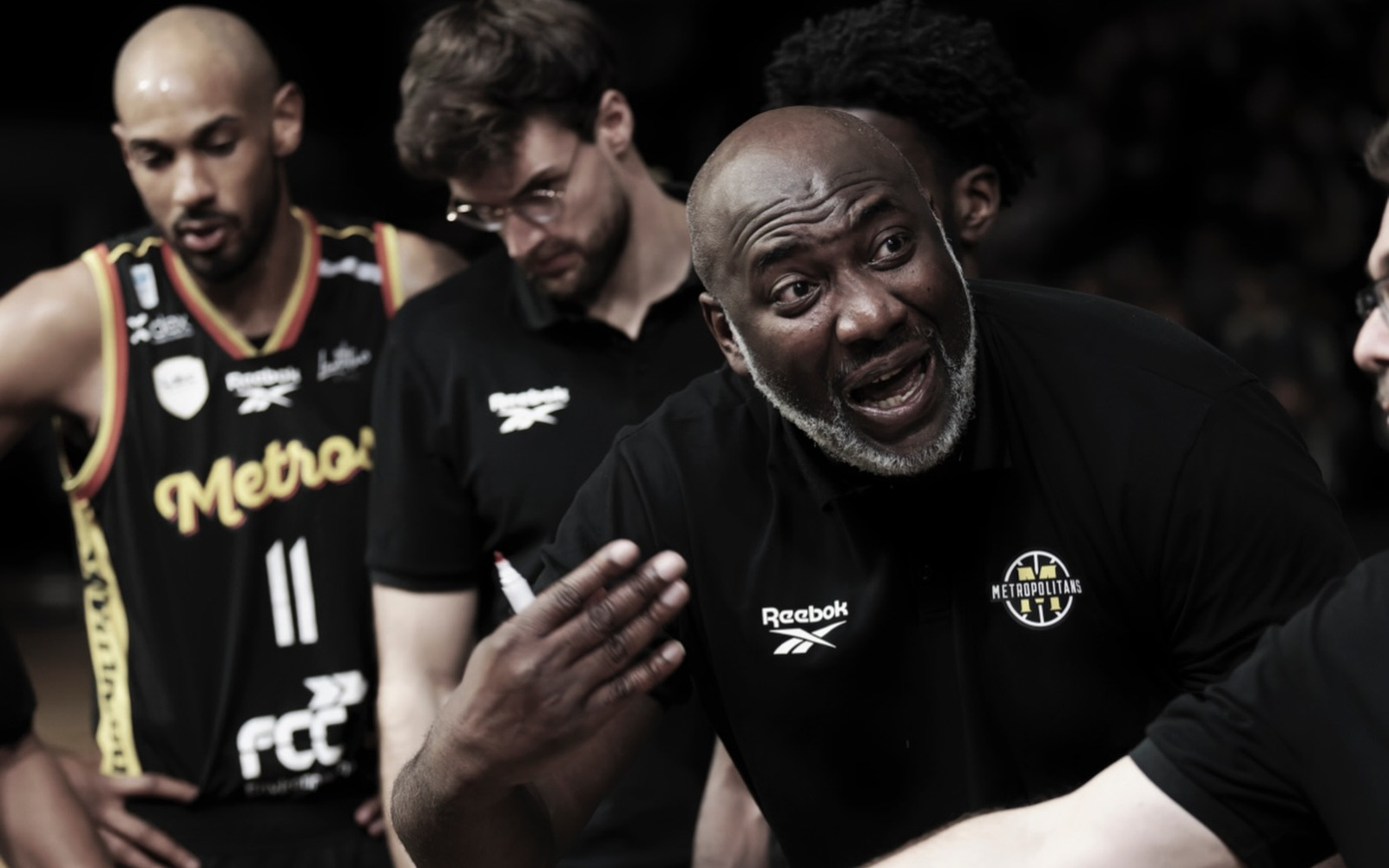
Sitting down with Levallois head coach Sacha Giffa after an intense preseason practice, the conversation quickly turns to what this club means to him. A championship-winning season in NM1 has brought the Metropolitans back into the professional ranks. Now comes the challenge of building on that foundation in Élite 2.
In the first of a two-part interview, Giffa reflects on returning to his roots, guiding the team through a rollercoaster championship campaign and preserving the chemistry that made it possible. He also explains how experience, young talent and a shared commitment to the team are shaping the next chapter.
Barr: In an age where a lot of player loyalty has shifted toward securing the best contracts, you navigated a totally different path when you played for the « Cardiac Kids. » Looking at how things have evolved today into a completely different era of French basketball, what was the defining factor outside of the game itself that made you want to come back and guide this club?
Giffa: It really comes down to my deep African roots and a profound desire to give back to the future generation. My identity is a complex blend of backgrounds. I was born in Russia, and my heritage brings together Togo and Cameroon, but I grew up entirely as a Paris kid. That unique upbringing shaped how I view the world and the game.
When you look at everything I have been blessed to learn throughout my journey in basketball, my core motivation now is to pass that knowledge directly down to youth. This is about an overwhelming love for a club, for French basketball, and for the city of Paris itself. They gave me a platform, an identity, and a home when I was coming up. Now that the club has fought its way back into the professional ranks, I feel a deep responsibility to ensure the next generation of Parisian talent receives that same guidance, structure, and basketball culture.
Barr: You played at the highest levels in Europe and represented Les Bleus. You transition to the bench where you have coached in the NBA Summer League and now with Metros lifting hardware last season. Are you a better coach or were you a better player?
Giffa: That is an excellent question, and honestly, I don’t really know the answer just yet. I have completely finished my journey as a player, and now I am fully invested in this exciting new journey as a coach. At the end of the day, I am not the one who gets to decide if I am a good coach or not. The only people who can truly answer that are the players I am coaching – they are the ones with the answers, even if those answers change from week to week.
Barr: When taking over as head coach, the club was in a difficult spot. The previous iterations, like Racing and the era with Tony Parker and Metros 92 with Victor Wembanyama moving through 92, had vanished. The team had to start over and has now earned promotion to Élite 2. What does that say about the philosophy required to handle such a difficult situation?
Giffa: It is all part of the game. Starting from scratch means teaching players that nothing in life or basketball is gifted. Success requires hard work, maximum daily effort, and understanding that rewards might not come today or in a week, but perhaps at the end of the season or a year later. Basketball is a sport of life and a sport of mistakes.
Barr: Looking back at the championship run in NM1, how would you describe the progression of the team through the ups and downs of the season?
Giffa: The season was a complete rollercoaster. After arriving with half a season to prepare, the team understood the desired philosophy, though managing roles with new players took time. The team started the second phase strong but then dropped four consecutive games. In Europe, losing four games is a month-long stretch that can destroy confidence, but it ultimately forced the group to rely on details, trust, and sharing the ball.
Barr: The team established an identity built on gritty, physical, defense-first basketball, but the backcourt completely caught fire during the playoffs. How did you get the players to buy into that during the tough stretches?
Giffa: It required reminding them of the big picture from the very beginning of the season. When the losing streak happened, the message was to get back to the roots of defensive values. By focusing heavily on defense, the team found its rhythm, shared the ball, and executed down the stretch.
Barr: Managing a team at this level comes with distinct challenges. Is it difficult to get that kind of buy-in from the lower levels compared to the highest levels of European basketball?
Giffa: It is incredibly tough because the new generation focuses heavily on highlights and wants to change subjects every two minutes rather than focusing on details. High-level basketball like the EuroLeague is entirely about specific roles and managing frustration. At lower levels, players easily get frustrated over not setting screens or not getting the ball, making ego and role management a massive part of the job.
Barr: When you look at how this team is put together for the step up to Élite 2, it is a unique formula. You didn’t just tear down the house after winning the NM1 championship. Instead, you have a distinct mix, bringing back veterans like Giovanni Onguechi, locking in young senior team promotions like Lionel Colson and Craig Adzeh , and mixing them with top-tier prospects like Tom Digbeu and new summer imports. From a tactical standpoint, how critical is this exact blend of players when you are trying to piece together the 2026–2027 roster?
Giffa: Keeping that core foundation intact was my absolute priority; I refused to break up the locker room chemistry we built. For me, this roster is about creating a legacy and « bringing our players home ». Vets like Giovanni understand our defensive values deeply, and keeping young guys like Lionel and Craig who sweat through that championship run ensures our grit carries over to the next level.
When you add a hungry NBA prospect like Digbeu who is looking for a career rebirth, or look at the new league rules allowing two American imports, you get an incredibly dangerous puzzle. On paper, we have an elite group of long, interchangeable athletes where everyone can swing between multiple positions. We don’t have one-dimensional players who only play the block or only stay at the point. If an opposing team tries to match our size, I can throw out a lineup featuring five guys who can all shoot out on the perimeter. This specific mix gives us total flexibility. It allows me to ride whoever has the hot hand on any given night, maintain a deep bench, and play a high-speed, intense tempo that will cause major defensive nightmares for every team in Élite 2.
